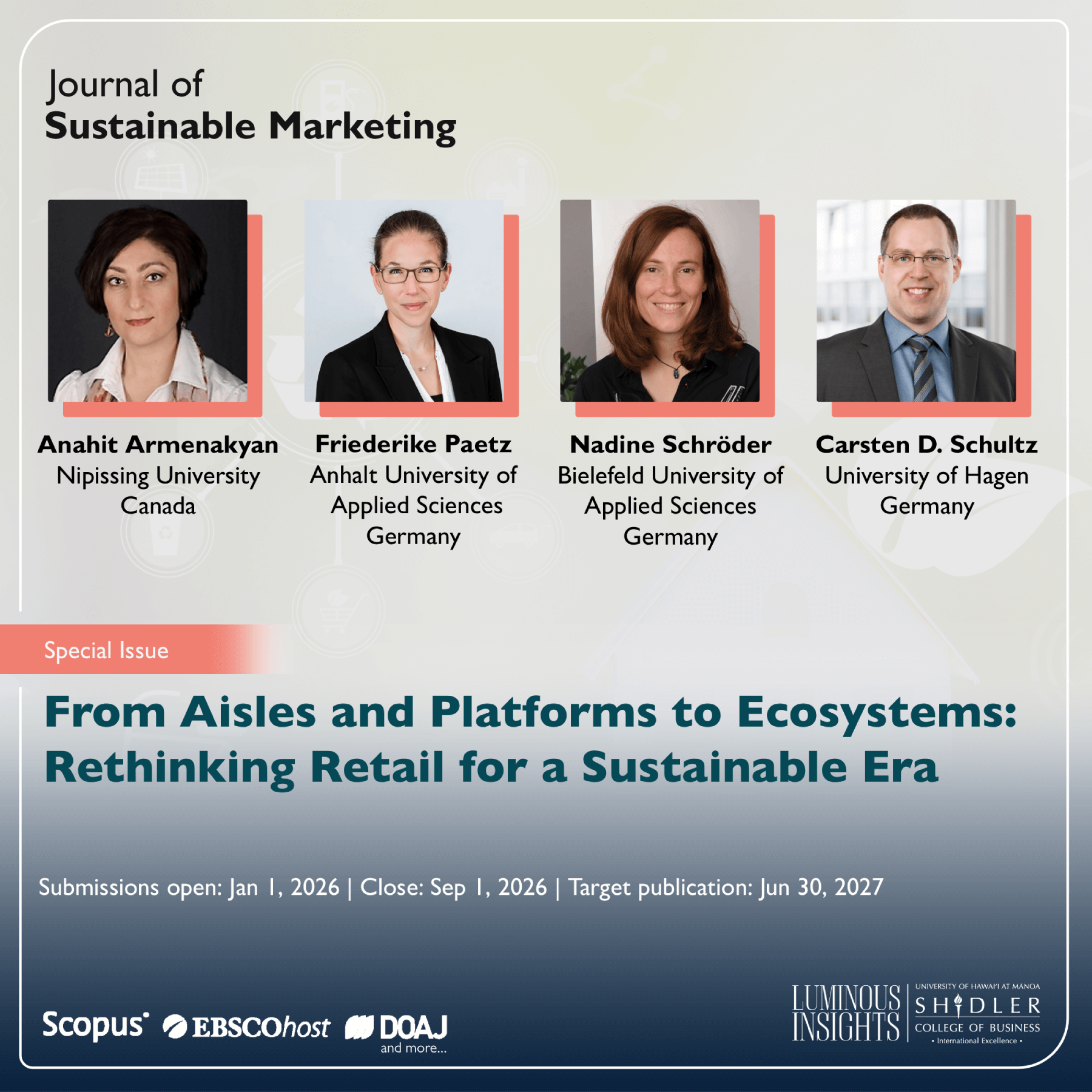
The Journal of Sustainable Marketing invites submissions for its upcoming Special Issue exploring how retail is evolving through digitalization and sustainability. We seek conceptual, empirical, and experimental research offering new insights into sustainable and responsible retailing.
Retail in Transition expresses the evolving retail landscape that is characterized by the ever-present need for adaptability. The dynamic retail landscape changes in light of both structural market shifts and broader socio-technical developments. On the one hand, horizontal and vertical tensions, competitive pressures, and shifts in value chains require strategic adaptation. On the other hand, transformative forces such as digitalization and sustainability are reshaping the foundations of retail activities. Against the background of this twin transformation (Tabares et al., 2025), the sustainable impact of digital innovations remains insufficiently explored in current research. Most importantly, sustainability represents one of the most urgent and complex challenges of our time that reconfigures managerial practices and consumer behavior.
Sustainable retailing involves the strategic consideration of economic, environmental, and social resources for the success of current and future generations (Vadakkepatt et al., 2021). This triple bottom line emphasizes the need to consider the long-term impact of retailer activities along the supply chain affecting the economic, social, and environmental developments. It includes developments such as corporate social responsibility (e.g., Ailawadi et al., 2013), greenwashing (e.g., Spielmann, 2021), and circular economy (e.g., Kristoffersen et al., 2020). With the proliferation of second-hand marketplaces (Styvén & Mariani, 2020), brands increasingly take ownerships of their previously owned markets (Hedegård, 2024). More recently, the term responsible retailing emphasizes the ethical obligations of the retailing industry to society (Holtrop et al., 2025). Sustainable and responsible retail practices may cover various stakeholders, such as customers, employees, and residents, but extends its focus towards the obligations of retailers to humanity and life in general.
The question of (un-)sustainability concerns all types of distribution channels (e.g., stationary and online retail) and channel management in retailing. For stationary retail, sustainability is increasingly relevant, for example, in areas such as energy-efficient store design, reduction of in-store waste, sustainable sourcing of products, and engagement with local communities. Brick-and-mortar stores are also under pressure to reduce their environmental footprint while enhancing social value, for instance, through inclusive employment practices or community-based initiatives. For online retail, sustainability challenges include the environmental cost of packaging, last-mile delivery emissions, and the energy consumption of the digital infrastructure. E-commerce further raises concerns about increased return rates, which amplify waste and carbon emissions. Digital retailers must explore sustainable logistics solutions and transparent communication about product sustainability in order to meet growing consumer expectations.
In retail channel management, sustainability requires a holistic and integrated approach across all customer touchpoints and supply chain interactions. This includes aligning sustainability goals across channels, reducing redundancies and inefficiencies, and ensuring ethical practices throughout the entire distribution system. Moreover, omnichannel strategies must account for the combined sustainability impact of digital and stationary retailing.
Retailers are already starting their route to responsible retailing. For example, fashion retailers, such as H&M and Patagonia promote product longevity and created return and recycle programs. Kotn, a Canadian middle market brand, works with farming communities to support cotton growers and invests in social structures. Food retailers (i.e., Gram, a small Swedish zero-waste food store) commit to reducing their footprints by offering unpackaged and bulk products and pay attention to reducing packaging across the supply chain. IKEA also offers circularity initiatives, uses sustainable wood and cotton and aims to become climate positive by 2030. Similarly, Amazon and Marks & Spencer target waste reduction and carbon neutrality. Naturally, new business models have emerged embracing a circular economy and responsible retailing. For example, Patagonia is a leading outdoor apparel company with deep-rooted environmental values and Rent the Runway offers fashion rental subscription boxes.
By providing a deeper understanding of sustainable retailing, the special issue aims to contribute to the research field of (un-)sustainable retailing. We invite conceptual, empirical, and experimental articles that provide novel contributions for retail research in this domain. We particularly encourage multidisciplinary research projects (e.g., projects building on environmental science, logistics, psychology, and other areas), data from diverse sources (e.g., secondary data, laboratory and field experiments, neurophysiological data, performance-related data, ethnographic work), multi-level analyses (e.g., consumer, firm, supply chain, policy), and longitudinal designs that capture the dynamics of the sustainable retail transitions over time. Paradoxes and trade-offs in sustainable retailing (i.e., balancing economic growth with environmental stewardship or digital convenience with circular economy) are also welcome. To this end, we do not encourage pure bibliometric mapping studies or descriptive reviews unless they clearly introduce new constructs, frameworks, or boundary conditions that advance theory in sustainable retailing. Similarly, we do not accept single studies based on variance-based structural equation modeling. Research topics and questions of interest for this special issue include, but are not limited to:
- Which determinants, e.g., consumer attitudes, governance goals, competitive pressure, affect the sustainable transition of retailers in which direction? Are there any differences between stationary and online retail stores?
- What role do stakeholders (companies, consumers, NGOs, policy makers, suppliers, etc.) play in shaping the success of sustainable retail transformation and creating shared value?
- What competitive advantages do retailers gain from integrating sustainability strategies? How does this affect short-term profits or long-term customer value and brand equity? How do retailers measure the impact of their sustainable practices across their overall business transactions?
- How do retailers manage and communicate the cost-sustainability paradox and how does this affect consumer trust and willingness to pay?
- How do personalization technologies influence sustainable consumption without triggering consumer skepticism on privacy and greenwashing?
- How does the emergence of new technologies, e.g., AI in retailing, contribute or even hamper the transition towards sustainable retail both from a retailer and a consumer perspective?
- Are consumers willing to engage in sustainable retail practices and under which conditions? For example, are there specific product categories in retailing, e.g., fresh produce, frozen food, personal care, cleaning, or beverages, that are more promising than others? Additionally, which products best support circularity programs, refillable options, or imperfect/irregular goods.
- How do consumers perceive sustainable retail transitions from a neuropsychological perspective? Do cultural backgrounds play a role?
- Which aspect of sustainability, i.e., social, ecological, is more important to customers when making a choice decision for specific retail channels? Does the importance of the sustainability attribute differ between online and stationary retailing per se?
- How should retailer’s information be designed to attract customers towards sustainability? How does providing of sustainable information influence customers along their customer journey?
- To what extent does sustainable practice labeling create benefits for both customers and retailers in online and offline retailing? How do these benefits differ across channels?
- What is the long-term impact of retailers’ sustainable practices on reducing unsustainable practices? To what extent do retailers’ sustainable initiatives contribute to the reduction of unsustainable practices in the long term?
- What are the most promising and effective sustainability strategies from operational, tactical, and strategic perspectives in stationary retailing versus online platforms? Where do commonalities and differences emerge?
- How do retailers’ strategies in previously owned markets (e.g., resale, recommerce, or second-hand platforms) influence consumer acceptance, brand perception, and the overall sustainability transition in retailing?
- Should “Fair Trade” practices be updated in order to contextualize within broader social and ethical issues in sustainable retailing?
- Which theoretical perspectives are most suitable for advancing sustainable retailing research? How can deductive approaches (e.g., theory-driven experiments or cross-sectional studies) and inductive approaches (e.g., exploratory work using large-scale databases) guide the development of new approaches and frameworks guide research and practice in sustainable retailing?
Co-editors:
Anahit Armenakyan anahita@nipissingu.ca
Friederike Paetz friederike.paetz@hs-anhalt.de
Nadine Schröder nadine.schroeder1@hsbi.de
Carsten D. Schultz carsten.schultz@fernuni-hagen.de
Special Issue Process and Timeline
All papers submitted to the Special Issue will follow the Journal of Sustainable Marketing review process, led by the special issue editors. To submit your manuscript, follow the manuscript submission guidelines outlined in the «Instructions for Authors» listed on the journal’s website (https://luminousinsights.net/journals/jsm ). Be sure to select the correct Special Issue.
The submission deadline is September 1, 2026. Accepted papers will be published in the Early Insights – Luminous Insights Online First Service within a month of manuscript acceptance.
The timeline of the special issue is as follows:
Activity Time
Manuscript submission window opens January 1, 2026
Manuscript submission window closes September 1, 2026
Targeted Publication Date June 30, 2027
For more details on this special issue, please visit: https://luminousinsights.net/journals/jsm/si/rrse
For inquiries about this Special Issue, please contact the guest editors at:
Anahit Armenakyan anahita@nipissingu.ca
Friederike Paetz friederike.paetz@hs-anhalt.de
Nadine Schröder nadine.schroeder1@hsbi.de
Carsten D. Schultz carsten.schultz@fernuni-hagen.de
References
Ailawadi, K. L., Neslin, S. A., Luan, Y. J. & Taylor, G. A. (2013). Does retailer CSR enhance behavioral loyalty? A case for benefit segmentation. International Journal of Research in Marketing, 31(2), 156–167. https://doi.org/10.1016/j.ijresmar.2013.09.003
Hedegård, L. (2024). (Re)framing used goods: marketing strategies in second-hand retail. International Journal of Retail & Distribution Management, 52(13), 136–153. https://doi.org/10.1108/ijrdm-05-2023-0300
Holtrop, N., Lobschat, L. & Ter Braak, A. (2025). Editorial: Paving the way for responsible retailing. Journal of Retailing, 101(1), 1–6. https://doi.org/10.1016/j.jretai.2025.02.006
Kristoffersen, E., Blomsma, F., Mikalef, P. & Li, J. (2020). The smart circular economy: A digital-enabled circular strategies framework for manufacturing companies. Journal of Business Research, 120, 241–261. https://doi.org/10.1016/j.jbusres.2020.07.044
Spielmann, N. (2021). Green is the New White: How Virtue Motivates Green Product Purchase. Journal of Business Ethics, 173(4), 759–776. https://doi.org/10.1007/s10551-020-04493-6
Styvén, M. E. & Mariani, M. M. (2020). Understanding the intention to buy secondhand clothing on sharing economy platforms: The influence of sustainability, distance from the consumption system, and economic motivations. Psychology and Marketing, 37(5), 724–739. https://doi.org/10.1002/mar.21334
Tabares, S., Parida, V. & Chirumalla, K. (2025). Twin transition in industrial organizations: Conceptualization, implementation framework, and research agenda. Technological Forecasting and Social Change, 213, 123995. https://doi.org/10.1016/j.techfore.2025.123995
Vadakkepatt, G. G., Winterich, K. P., Mittal, V., Zinn, W., Beitelspacher, L., Aloysius, J., Ginger, J. & Reilman, J. (2021). Sustainable retailing. Journal of Retailing, 97(1), 62–80. https://doi.org/10.1016/j.jretai.2020.10.008